Manufacturing for Agentic AI
How to Transform Kiln Optimization & Predictive Maintenance through Agentic UX?
Scaling Kiln Optimization in Cement Manufacturing through Multi-Model Agentic UX
Scroll to exploreScaling Kiln Optimization in Cement Manufacturing through Multi-Model Agentic UX
Scroll to exploreIn industrial cement manufacturing, the kiln serves as a mission-critical heart where even minor fluctuations in flame stability can escalate operational costs by 37.5%. Field technicians operate in a high-stakes, volatile environment defined by extreme cognitive load, where they must synthesize vast amounts of raw data from multiple interdependent sources while facing intense pressure to prevent downtime that costs 25% loss. To mitigate user fatigue and the "trust gap" inherent in traditional black-box systems, I designed a Predictive Maintenance Ecosystem that utilizes Agentic AI to provide real-time, accurate analysis.
By integrating a Concept of Control Tower & Digital Twin Simulation Interface, the system empowers technicians to visualize outcomes and financial ROI before implementation, transforming complex industrial data into a safer, quick, and confident decision-making process.

Defining the problem space and opportunity for innovation
In the high-stakes environment of cement manufacturing, kiln optimization is a mission-critical process where a single performance anomaly can result in downtime costs of $4,000/hr. This volatile setting demands extreme precision, as even minor fluctuations in variables like airflow or temperature can double operational costs and compromise product integrity.
Manufacturing industries face massive risks due to the interconnected nature of their systems, specifically within kiln operations where temperature and fuel variables are notoriously difficult to balance. Traditional predictive maintenance often lacks the real-time accuracy and ecosystem-level planning required to solve these complexities, necessitating a more advanced, strategic AI solution.
The objective is to pioneer a new era of industrial innovation by orchestrating the power of Agentic AI to solve deeply "human" problems like cognitive overload and decision fatigue. By automating complex troubleshooting, we empower engineers to shift from reactive monitoring to strategic, data-driven optimization.
This project demonstrates how Agentic AI serves as a sophisticated co-pilot in industries requiring rapid, high-stakes data synthesis. By providing real-time root cause analysis and predictive simulations, the system transforms complex backend data into actionable insights, allowing for confident decision-making when every second counts.
I pioneered the industry-first "Control Tower" concept—an Agentic AI framework designed to orchestrate the complex coordination of humans and AI across different analytical layers.
Strategized a scalable blueprint for predictive maintenance, bridging the gap between high-level AI reasoning and actionable UX across the manufacturing sector.
Applied domain research to simplify high-risk, data-heavy operations, AI, Agentic AI & human collaboration.
Designed digital wireframes to validate core visual representation and task flows early in the process.
The transition from a "fun" interface to a "productive" one that solves the real-world problem

My research phase was defined by deep immersion into high-stakes decision-making environments. I observed a recurring friction point: the “Trust Gap” between a technician’s intuition and the AI’s logic. To bridge this, I looked beyond traditional enterprise software and began analyzing the architecture of complex simulation games, specifically titles like Cities: Skylines and Inzoi.


I was fascinated by how simulation games manage hundreds of interdependent variables—such as traffic, economy, and urban growth—without overwhelming the player. This complexity mirrors the interconnected systems of kiln optimization, where temperature, airflow, and fuel must be perfectly balanced to maintain stability.
By studying “Command and Control” principles from gaming UX, I developed a strategy to prevent user fatigue in industrial settings. I applied these principles to the Control Tower solution in three distinct ways to ensure a seamless transition from data synthesis to actionable decision-making.
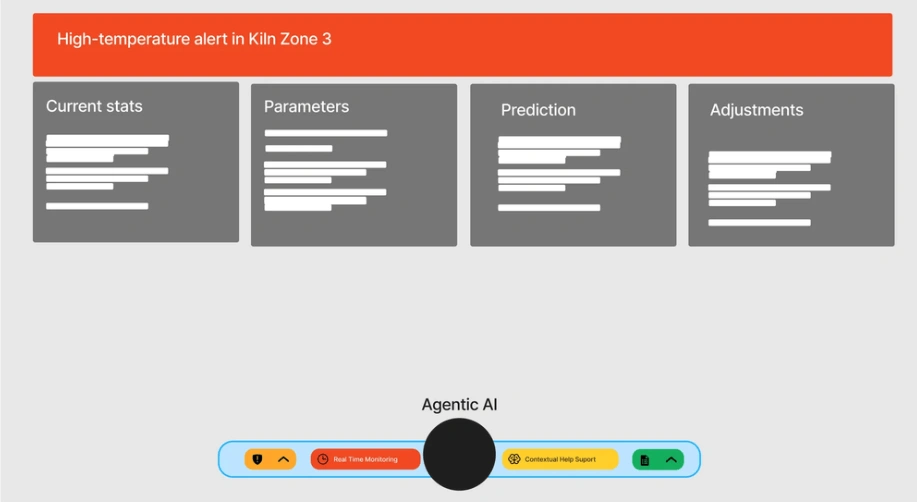
Just as simulation games provide a "god-view" analytical layer, the Control Tower acts as a transparent filter between raw sensor data and the final implementation, synthesizing "Initial Findings" into actionable insights.
Inspired by Inzoi’s autonomous agents, I designed the AI to be non-intrusive yet omnipresent. The agents operate in the background—monitoring primary airflow and fuel rates—only surfacing during critical anomalies to offer a Recommended Action"
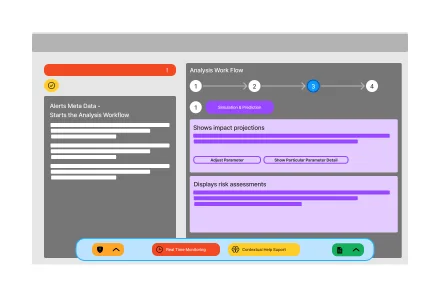
I translated the "what-if" mechanics of simulation games into a Digital Twin Simulation Interface. This allows engineers to visualize the ROI of a fix—such as reducing costs to $250/hr—in a risk-free environment before the workflow is finalized.
Deep insights gathered through multiple research methodologies
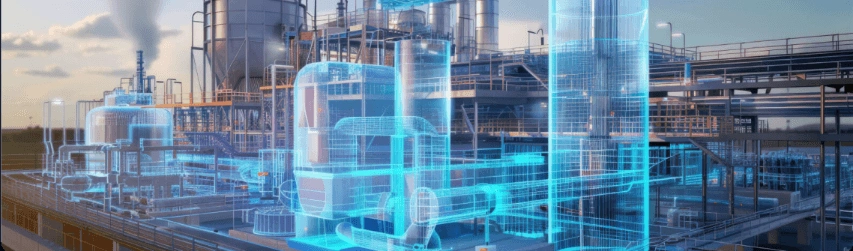
My research phase followed a rigorous deep-dive methodology, moving from macro-level domain understanding to granular process flow analysis. By mapping the end-to-end cement production process, I identified the Rotary Kiln as the most volatile and mission-critical stage of production. This domain research revealed a "symphony of variables" where factors like temperature, primary/secondary airflow, and material composition are deeply interdependent. This high-stakes environment carries a significant financial burden, with performance anomalies potentially costing over $4,000 per hour in downtime.
To understand the human element of this complexity, I conducted a technical audit of current maintenance workflows and requirement gathering sessions. I focused specifically on the "Burning Zone" to determine where sensor data is most prone to fluctuation. A primary requirement identified was the need for "Predictive Fidelity" the ability for engineers to distinguish specific root causes from a sea of raw data points, rather than just receiving a generic alert.
By cross-referencing these process flows with user observations, I pinpointed critical challenge areas where human cognitive limits collide with high-speed machinery. Engineers face a "Data Synthesis Paradox," where they are overwhelmed by vast amounts of raw data from multiple sources. This results in profound "User Fatigue," leading to inefficient decision-making and errors. Furthermore, a significant "Trust Gap" exists because traditional AI systems often lack visibility into how decisions are made, making engineers hesitant to follow recommendations during crises.
Finally, I identified severe operational risks stemming from manual response latency and lack of simulation. By the time a human identifies a drop in flame stability often falling from 92% to 70% operational costs have already doubled. Without a simulation layer, every corrective action is a "live experiment" on expensive machinery. This research underscored the necessity for an analytical layer between the problem and the solution a Control Tower that utilizes Agentic AI to simulate environments and provide actionable, transparent insights in real time.
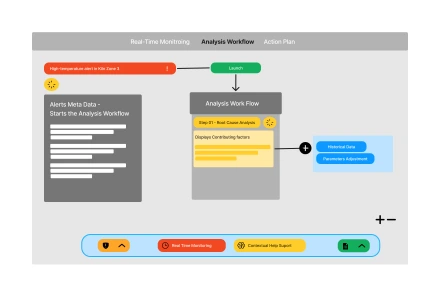
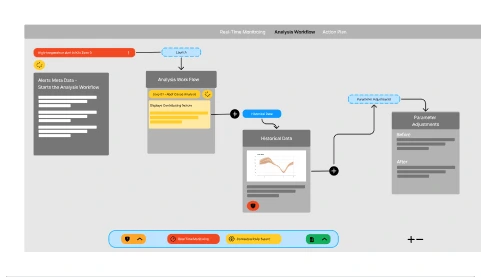
In collaboration with the VP of Technology, I architected a high-fidelity user journey that bridges complex Agentic AI capabilities with intuitive UX. This partnership was critical in mapping a seamless path from raw anomaly detection to verified implementation, ensuring the technical backend directly supported the engineer's need for precision. By prioritizing engineer agency and system safety, we transformed a high-pressure diagnostic process into a structured, manageable workflow.
Our framework streamlines the decision-making process by synthesizing vast industrial data into actionable, simulated scenarios that minimize cognitive friction. By integrating "What-If" simulations directly into the flow, we empowered technicians to validate outcomes before execution, maximizing decision accuracy in high-stakes environments. This strategic alignment ensures that every intervention is data-backed and human-verified, significantly reducing the risk of costly operational errors.
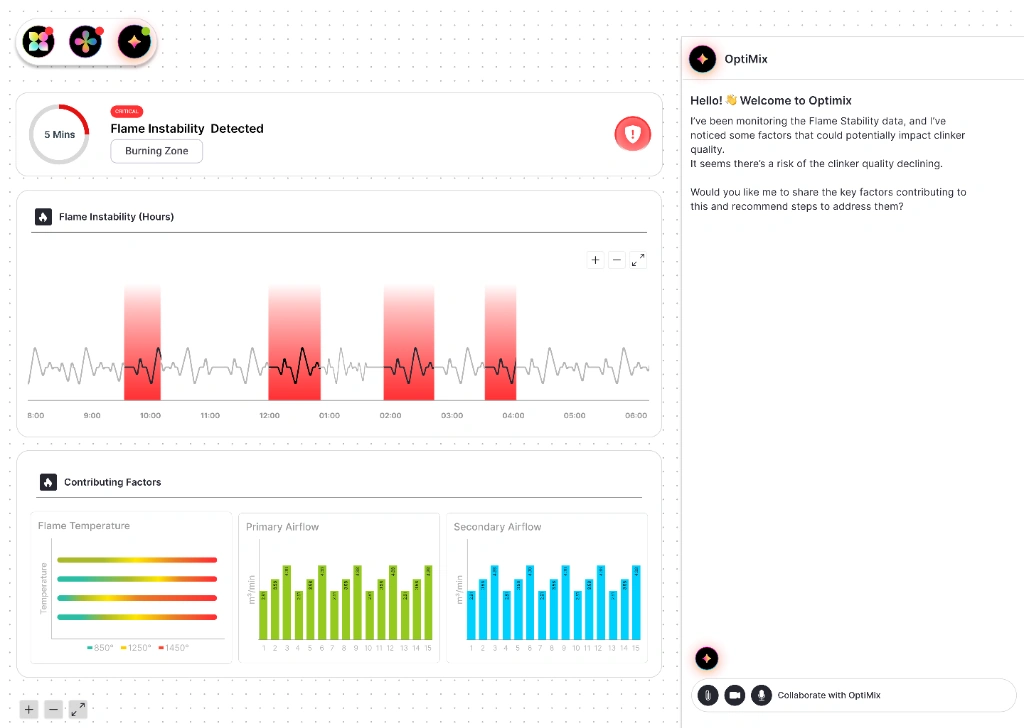
The system acts as a high-velocity intermediary, instantly synthesizing contributing factors like an 8% airflow drop or 12% fuel variance to eliminate manual troubleshooting and user fatigue.
The system acts as a high-velocity intermediary, instantly synthesizing contributing factors like an 8% airflow drop or 12% fuel variance to eliminate manual troubleshooting and user fatigue.
The system mimics real-world results in the digital twin, forecasting 85%+ stability and a $150/hr cost reduction, empowering the engineer to act as the final, confident approver of the implementation.
End-to-end interactive journey from telemetry anomaly trigger to engineer confirmation, integrating what-if validation loops and automated execution.

Deep insights gathered through multiple research methodologies
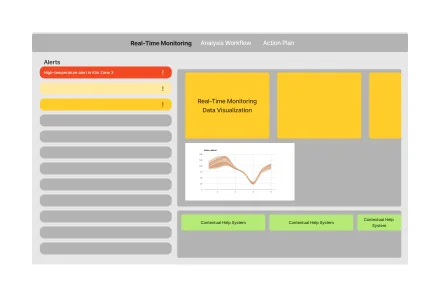
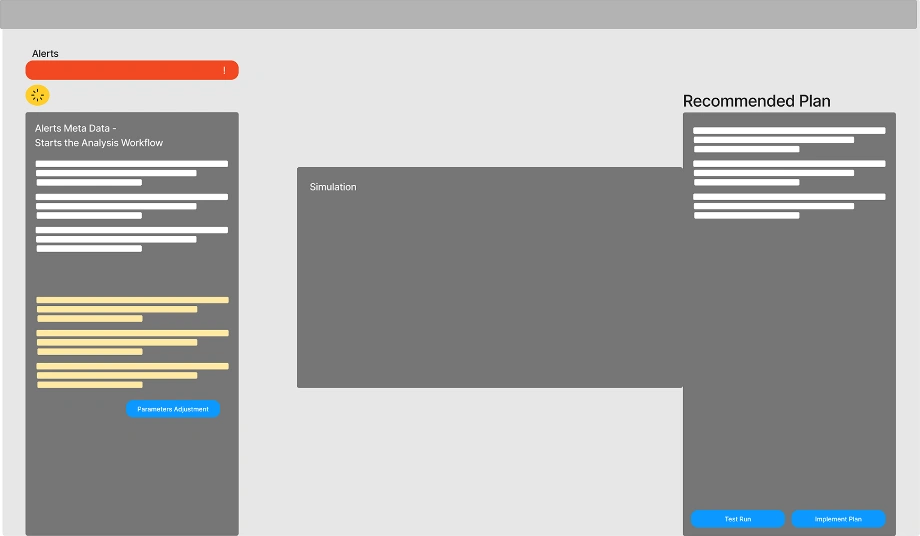
Transforming insights into impactful design decisions
Full-scale digital twin visualizations, real-time hotspot detection, and conversational AI co-pilot screens deployed for clinker operations.
Insights and takeaways from the design process
Introduced dedicated UX sessions separate from scrum ceremonies to align early with Product Owners & stakeholder.
Conducted recurring syncs with stakeholders and users to gain real-world clarity on operational challenges.
Established that a clear understanding of the existing ecosystem directly leads to more effective, unified solutions.